
Vending machine for white T-shirts
A concept for a machine that sells exactly one thing: a white 100% cotton T-shirt in its own vacuum pack. I designed the graphics of the cabinet and the pack, worked out how it dispenses and built an interactive diagram to show how the machine works inside.

One item instead of a shop
A white T-shirt is the simplest thing to sell from a machine: no colours, prints or models, only a size to choose. The whole purchase fits into three actions: pick a size, pay, take the pack from the tray.
So the interface almost disappears and the product itself takes centre stage: the pack with the T-shirt has to be visible, clear and recognisable from a distance. Such a machine suits places where a T-shirt is needed right now: stations and airports, festivals, coworking spaces and gyms.
A machine worn like a T-shirt
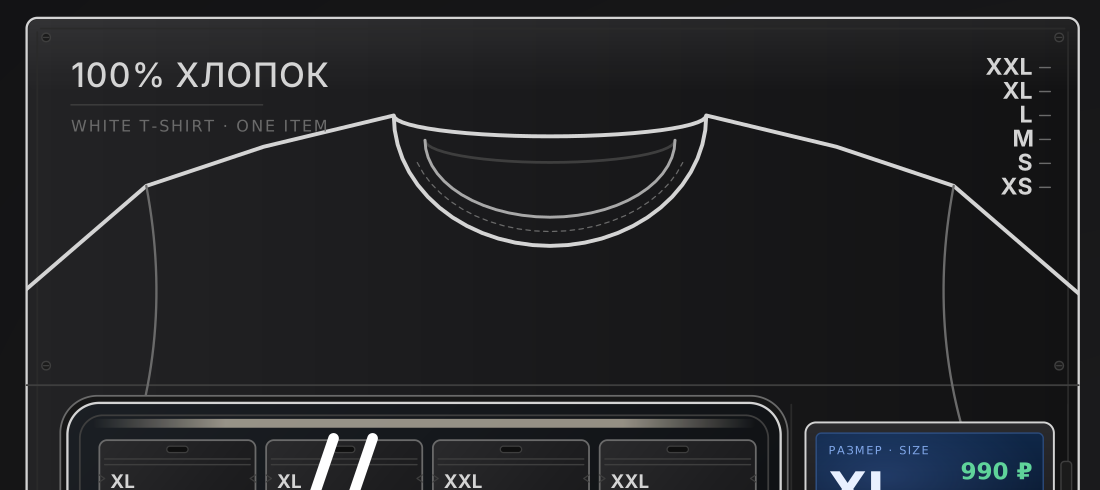
The main image is a T-shirt outline across the full height of the cabinet: collar, shoulders and sleeves at the top, the hem at the bottom. The line is dark navy and everything else is white on white: cabinet, packs and background share one tone, so only the outline works.
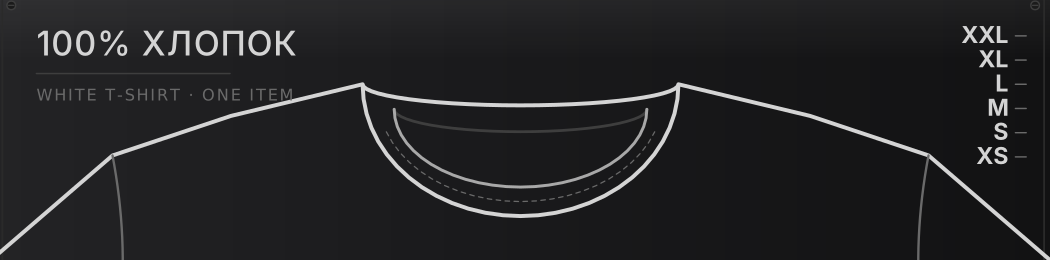
The machine header: “100% cotton” on the left and a vertical size list from XXL to XS on the right.
The display sits where the chest of the shirt is and the delivery tray is at the hem. The machine reads as clothing before anyone walks up and reads “White T-shirt” on the base.
A 4 × 3 window
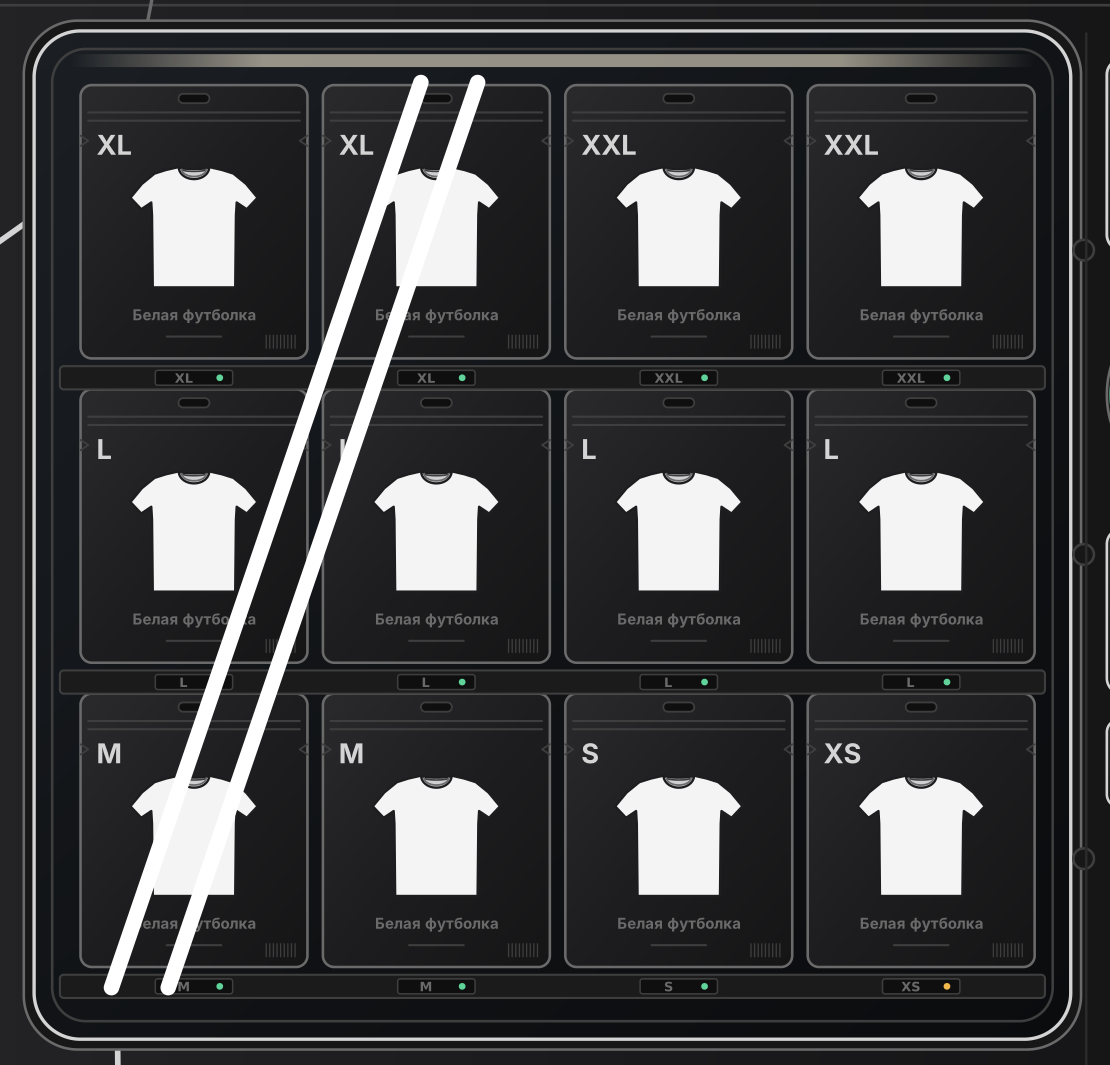
The window holds twelve cells: four columns and three rows. Each cell has a T-shirt pack standing on its edge, facing the customer, so the print on the pack is both the product and the advertisement.
| Row | Sizes by cell, left to right |
|---|---|
| Top | XL · XL · XXL · XXL |
| Middle | L · L · L · L |
| Bottom | M · M · S · XS |
The size is printed in the corner of every pack and repeated in the list in the header, so people find it by eye instead of reading a label. In the concept the split is: L four cells, XL, XXL and M two each, S and XS one each. In a real machine it should be checked against sales at the actual location.
The pack is the product window
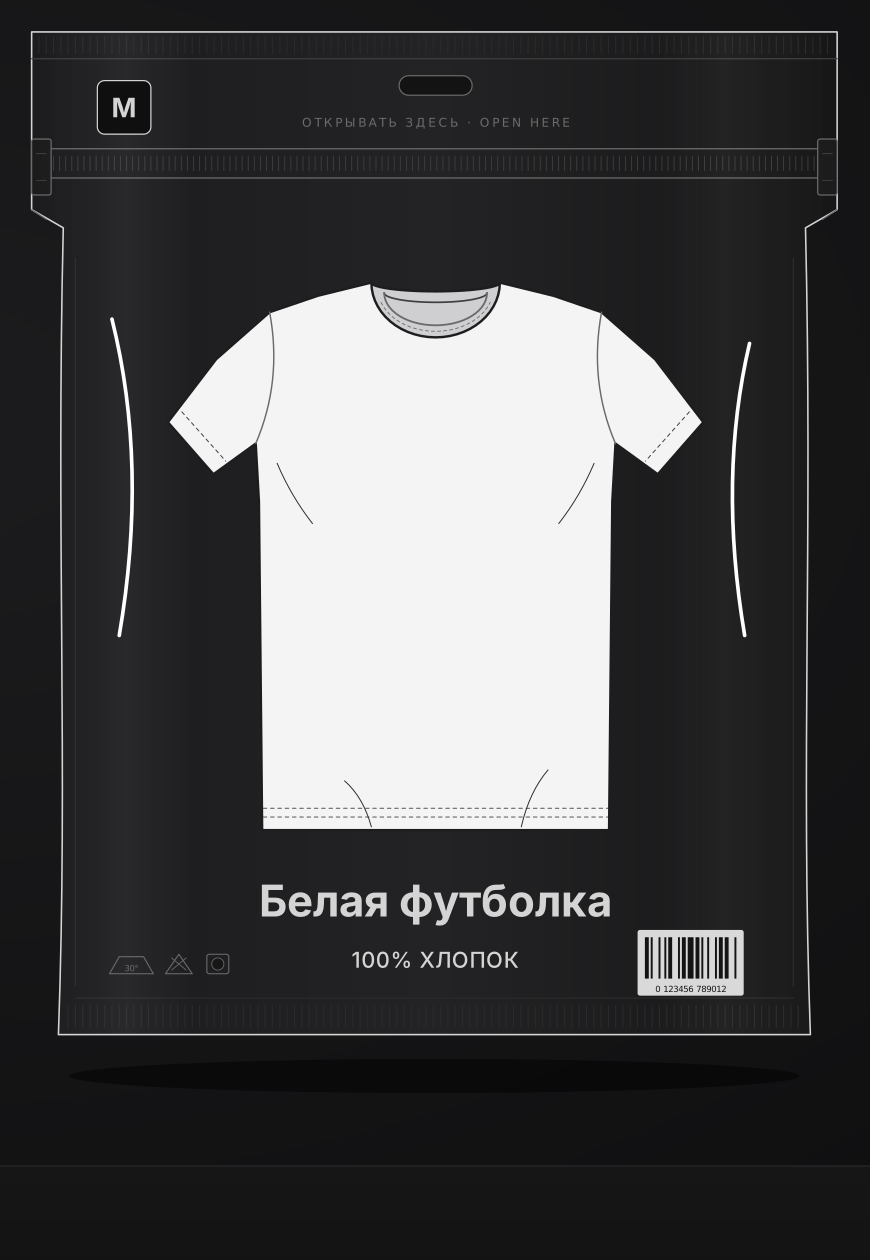

Every T-shirt sits in its own zip-lock pack: matte silver-white film with a black T-shirt outline on the front, the name “White T-shirt” and the line “100% COTTON”. The pack repeats the graphics of the machine in miniature, so the packaging and the machine read as one system.
The vacuum makes the stack compact: packs stand on edge in dense rows, and the zip lets you close the T-shirt again if it is not taken away at once.
The pack, exploded
To show what the pack is made of I took it apart into layers: the back film, the folded T-shirt and the front film with the print. Move the cursor across the diagram and the layers slide apart on their rails; hover a layer to see its name.
The control column
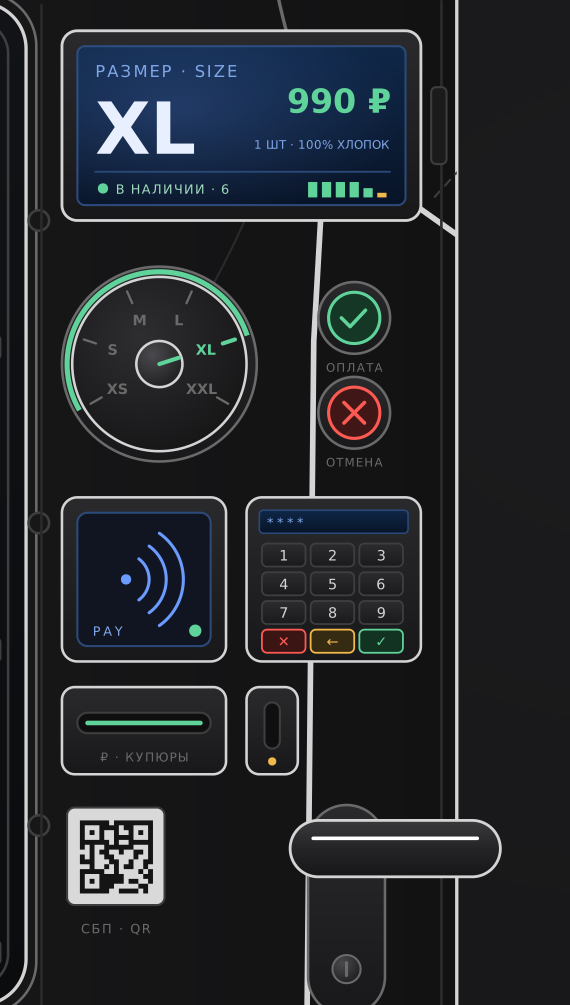
To the right of the display there is a narrow control column: a display window, a payment terminal with a keypad and a heavy handle for the service door. Everything that needs interaction is collected into one vertical, so the rest of the cabinet stays clean.
In the concept the display shows the chosen size in large type, the terminal takes the payment and the pack is delivered to the tray in the base under the display.
The machine inside
To show the mechanics I built an interactive isometric diagram. The left wall is removed, so you can see the stacks of packs, the springs, the gantry with suction cups and the delivery tray. Click any cell and the machine vends that size; on its own it walks through the cells in a loop.
- The customer picks a size, for example XL, and the gantry drives to the right cell: the beam on two vertical guides, the carriage along the beam.
- A plate with four suction cups extends and presses on the first pack. The smooth film holds on suction cups, so no grippers are needed that could crease the T-shirt.
- The plate retracts and pulls the pack out; the rest of the stack is pushed forward by a spring on a pusher, and the next pack becomes the first.
- The carriage carries the pack to the tray and lets go; the pack settles on the tray floor.
- The tray hatch opens, the customer takes the T-shirt, the hatch closes and the machine is ready for the next order.
The diagram illustrates the idea and is not a drawing for production: mechanism sizes are conditional and the number of packs in a cell (eight in the diagram) is chosen for clarity.
Design decisions
| Decision | Why |
|---|---|
| A T-shirt outline across the whole cabinet | The machine is recognised from afar and explains what it sells |
| White on white and one dark line | Graphics are the only accent, the product does not compete with the background |
| A 4 × 3 grid window | All sizes are visible at once, no on-screen menu needed |
| The size in the pack corner and in the header list | People find the size by eye, not by reading |
| One model, one pack | Minimum interface: size, payment, tray |
| A delivery tray with a hatch | The pack does not drop or crease, the hatch opens only at pick-up |
What next
This is a concept: the machine and the pack exist as a visualisation and a diagram. Before production it is worth testing on a prototype:
- how the suction cups behave on real vacuum packs: slipping, film friction, the stack sliding;
- cell capacity and restocking: how many packs fit in a stack and how fast staff can load them;
- payment and fiscal requirements for the actual location;
- vandal protection and the climate inside the cabinet: humidity and temperature swings for cotton and film.
What I did in this project: designed the visual system of the machine and the pack, laid out the purchase path, designed the dispensing scheme and turned it into an interactive illustration.
The line-up: black and colour
The machine is designed as a system rather than a single object. The 4 × 3 grid, the pack and the cabinet graphics work for any basic item — only the T-shirt colour and the lettering change.
Black T-shirt
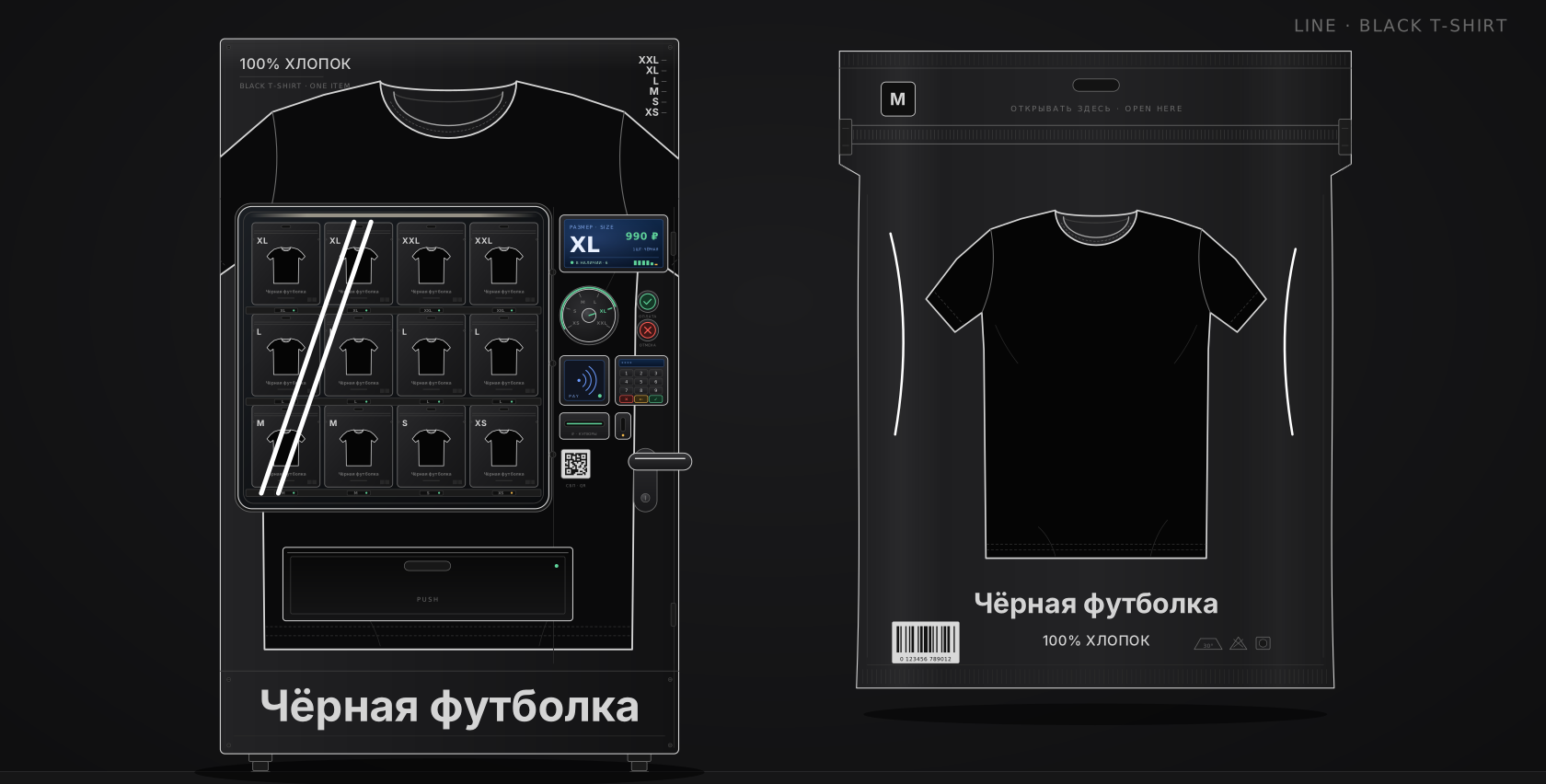
In the black line the cabinet, the window and the pack stay the same, while the T-shirt outline on the machine and the print on the pack are filled with black. The plinth and the pack read “Black T-shirt”: the silhouette and the name tell you which machine it is before you come close.
Colour T-shirts
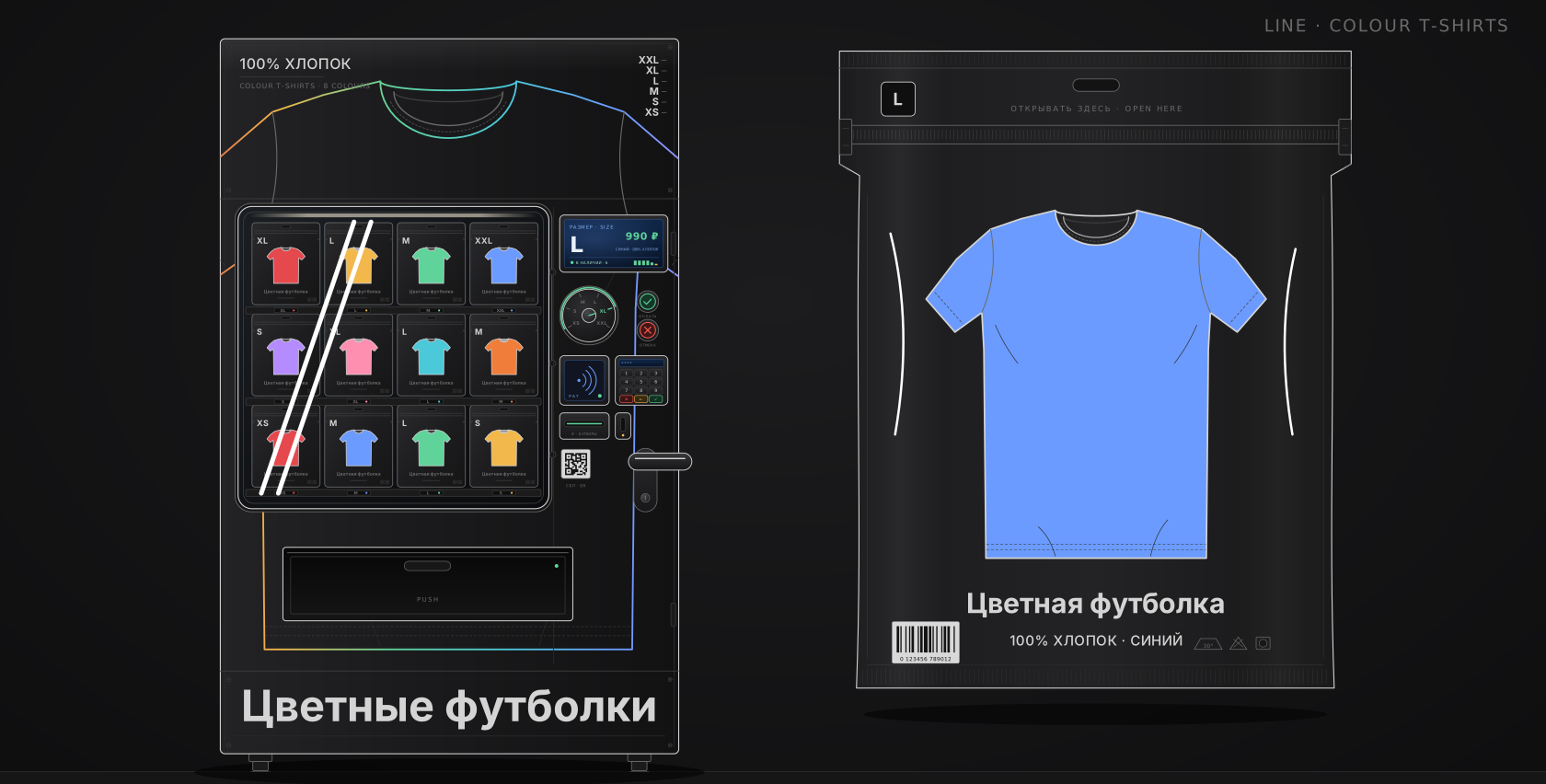
In the colour machine every cell is its own colour and size: a red XL, a yellow L, a blue XXL and so on. The outline on the cabinet becomes a gradient, the pack gets a colour fill, and the display shows the size together with the colour.
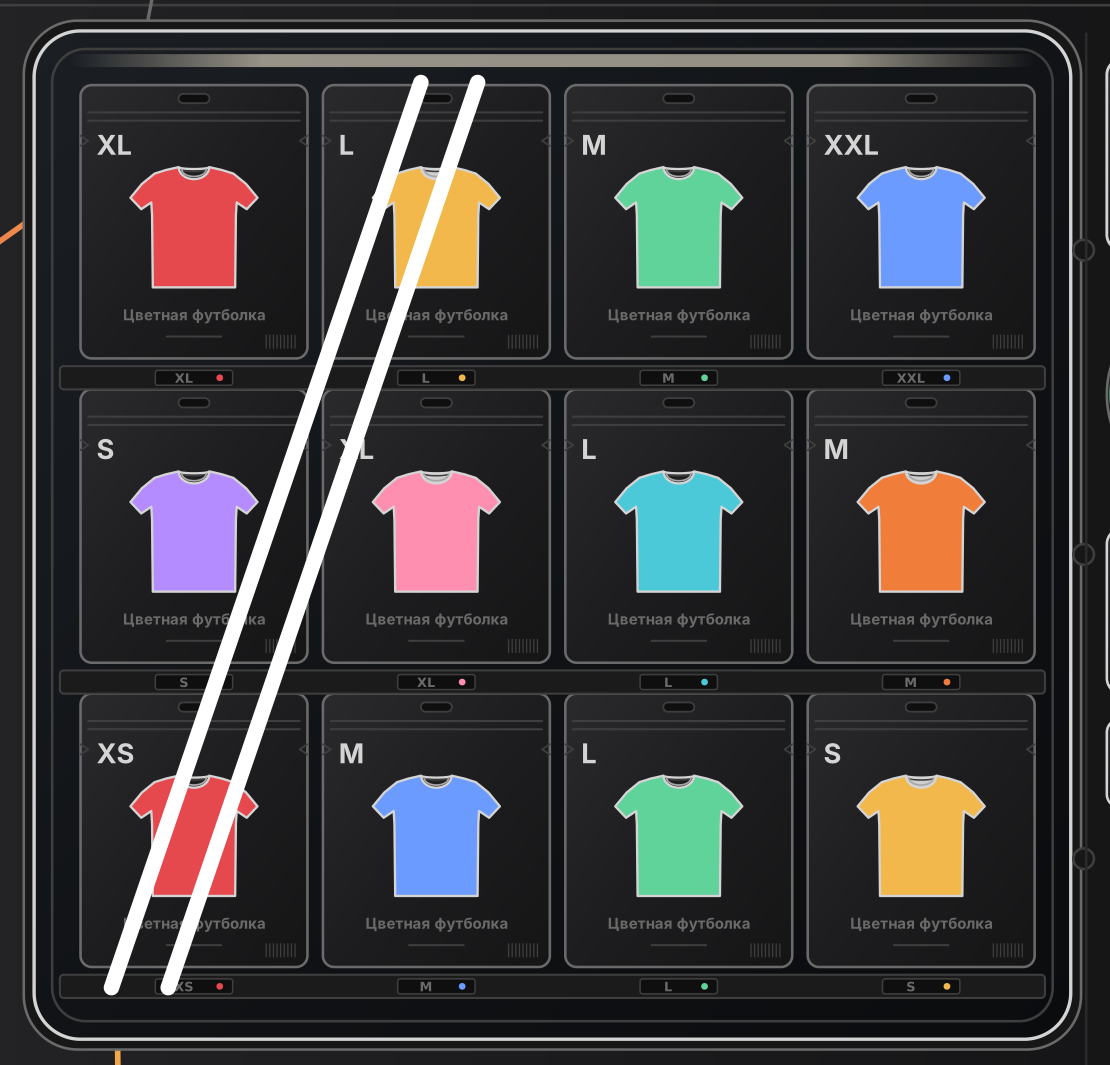
The grid and the dispensing mechanics do not change, so the range can be set up for a particular spot: one place needs only black L and XL, another eight colours in kids’ sizes. The light under each cell repeats the T-shirt colour, so the window reads without any lettering.